Thursday, October 18, 2012

Meet Author Gretchen Craig

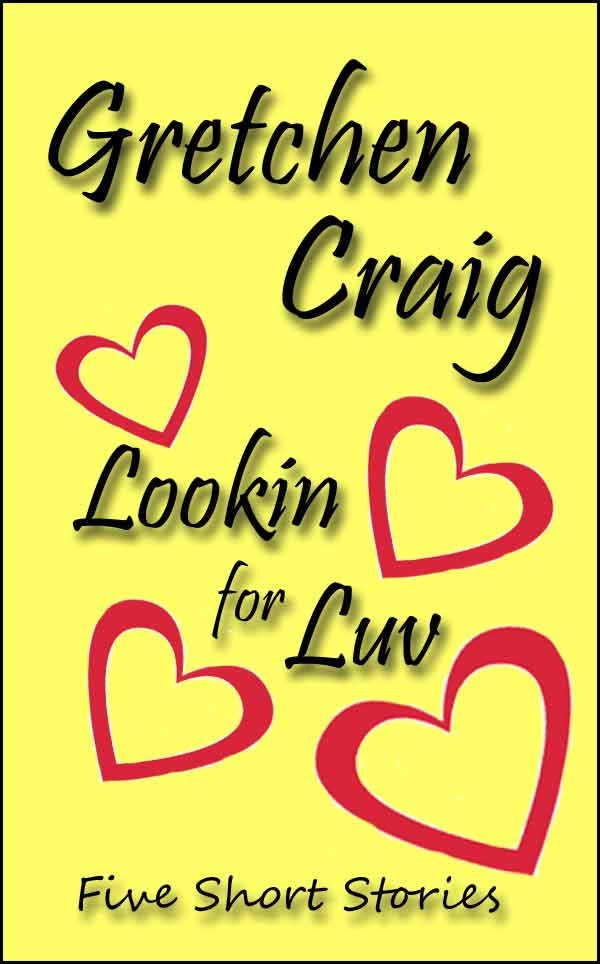
Meet Gretchen Craig! She's a dear friend from Texas who writes dramatic love stories with a tremendous sense of place. But she recently branched out with a set of light love stories. 

You can find out a lot more about her here. Since she is both a traditionally published and self-published author, I think you will find this interview interesting.

Susan: I know your work and it's been admired for its drama and deep emotion. Your book, Lookin for Luv, is a departure from this. Did the stories come to you all at once or have you been concocting these upbeat tales while you were busy writing your longer, more dramatic novels? 

Gretchen: Yes, these are much lighter stories than what I usually write. I was involved in a novel full of angst and suffering, and I just needed a break. I’ve enjoyed reading light contemporary romance, and I thought I’d just give it a try. So they were done over several months whenever I needed a respite from the sturm und drang of my longer work. I had a lot of fun writing them.
 
Susan: These are all Louisiana stories. Your view of life on a houseboat on a South Louisiana bayou is so detailed and realistic. As a Louisiana girl myself, I know how well you evoke that setting. How do you do that kind of research and how do you get into a sense of place?
On Amazon Kindle
Gretchen: I’ve done a lot of book and library research about Louisiana history over the years, but for the feel of a place, I rely on having actually been to the bayous. I haven’t really spent much time there, just an airboat tour, and lots of driving in the countryside. But I lived near the Everglades for years and I know what humidity and heat and water and swamp are all about. The rest is imagination, and place has always been a strong stimulant for me. Everywhere I go, I see myself living there, especially if it’s combined with a sense of the place’s history (as in my pueblo novel set in 1599). The only place I’ve ever been that I thought I would not like to stay is a terribly poor, barren little town on the high plains of New Mexico. Everywhere else pulls at me to come explore and stay a while.

Susan: As a traditionally published author who's garnered success, awards and great reviews, why did you decide to go into e-book self-publishing?

Gretchen: The e-book question. It’s all so complicated these days. I still do query the major houses with new manuscripts, but I am grateful that in this era we authors do have other options. I do want an audience, and I’m gratified to be able to reach readers this way.

Susan: Do you have a e-book reader yourself?

Gretchen: I have a Kindle. I still love to have a book in my hands, and if it’s a book that I want to study, particularly non-fiction, I want a paper copy so I can check back to earlier passages and easily find sections I want to re-read. And to annotate with a colored marker. The Kindle enables some of that, but for me, it’s clumsier than a pen and dog-eared page. What I especially like about my Kindle, though, is the incredible number of titles available, and I can get them next thing to instantly. That’s pretty cool.

Susan: Do you think more authors will straddle both the traditional publishing and the self-publishing world? And are you planning to publish more books with traditional publishers? 

Gretchen: I do think more authors will pursue self-publishing. And many of us still want to be traditionally published as well. There is a certain validation in having a big house take you on and promote you, and they can reach readers that self-e-publishing does not. I certainly have hopes of continuing to publish in both venues.

Susan: I know that you travel for inspiration. Are there other writers who inspire you?

Gretchen: I’m constantly inspired by other writers, from all different genres. I’ve recently discovered Richard Ford, who’s been acclaimed for a long time, but I hadn’t come across him. His novels are tagged as literary; some of his novels feature the same protagonist, Frank Bascomb, who is a man who constantly struggles to find an equilibrium in life, to find happiness and to accept life as it is. That speaks strongly to me at this particular time in my own life. And there are romance authors who write outstanding novels even though they are seldom given critical respect because they are writing in romance. I admire Mary Balogh and Judith Ivory for depth of feeling and character in their historical romances. I’m very impressed with Michel Faber’s big novel The Crimson Petal and the White, which is a historical set in Victorian times.  I also have just finished another Lee Child novel featuring Jack Reacher – Die Trying – that I couldn’t put down. I read lots of different kinds of books, and the best ones always have something to teach about pacing or characterizations or mood, or best of all, just life.

Susan: What's your next project? 

Gretchen: I haven’t decided on my next topic. I have several possibilities perking in the background, but I might decide to try something new. These light romances have made me smile, myself, as I wrote them. Maybe I’ll think about something longer along those lines, though I’m not as funny as some writers, like Susan Denney, for example. 

 Thanks to Gretchen for insights into her writing process and the changing world of publishing!


Thursday, August 23, 2012

Kids' magazines --Gotta love them!

http://www.cobblestonepub.com/magazine/cal/

Have I said how much I love writing for children's magazines? The pay is not spectacular. But knowing that thousands of children will read what I wrote is still a thrill. And I've even had an article translated into other languages. I like the succinctness of writing for a children's magazine. You can't be wordy and you can't pad either. It's all content or die trying.

There's also the memories of having a subscription to Jack and Jill  many years ago, and the vivid recollection of My Weekly Reader  in elementary school. 

If the only experience you have with kids' magazines is in doctors' waiting rooms, I encourage you to look around. There's a lot more out there.

I just finished several articles for Calliope, a world history magazine for 9-14-year-olds. It's published by Carus which also publishes Cricket, Cobblestone, and a ton of other magazines.

The topic was "The Orchestra" and I really got into it. I'll reveal more about what the articles are like when we get closer to publication date.

But I learned a lot and got to talk to some seriously amazing  people about the music they make.

Look at the cover of September's issue. Pretty cool, huh?

If you want to give a child a perfect gift, think of a subscription to a magazine. Getting mail is beyond cool when you're a kid. The thrill of getting a new issue every month adds to the excitement that all children should feel about reading.


Tuesday, July 17, 2012

Interview with Braden Bell--Middle School Magician

I enjoyed learning more about Braden Bell, author of Middle School Magic: The Kindling. I hope you will too.

His book has the fabulous premise that middle school students with magical powers "kindle" as their powers show themselves. And some of their teachers have super powers too. Cool! Braden teaches middle school himself which proves he's a brave man.

The story revolves around three "kindling" students, Conner, Melanie and Lexa. It's action packed and sets up a distinct and fascinating magical world. Thanks to Braden for taking the time to answer my questions.

Susan: Since you're a middle school teacher yourself, you have an amazing window into that environment. How hard was it to keep "real" people you work with or the memory of your teachers from middle school out of your manuscript? Are those teachers in The Kindling an amalgam of other teachers you've known or did they come from somewhere else?

Braden: That's an excellent question, one I'm glad to be asked. The reality is that the teachers and students very quickly took on a life of their own. I know that may sound strange to people who have not written a book, but it's really quite true. Many writers feel that their characters tell them what to do rather than vice versa, and that was the case. I had a few people in mind when I started, from whom I borrowed some vocal inflections or a personality trait, but the characters very quickly evolved into their own people. Now, when I imagine them or am writing their dialogue they don't resemble anyone I know. 

Susan: I loved  that the French teacher was important to the story and also very nice since I was one myself. Any reason why you picked French?
 
Braden: If you were to take a poll at my school among parents and students of the person who is most beloved and influential, it would be our French teacher. She's taught for many years and has a special gift. She's one of the people I most admire professionally and I wanted to pay tribute to that. But there's a more practical reason. In an early draft, all the teachers were Mrs. and Mr. It looked repetitious and a little boring. I felt like I needed to break it up. So, I gave the choir teacher a doctorate so he could be Dr. instead of Mr. And I figured if I used a French teacher I could use Madame instead of Mrs. Finally, the character just taught French. I knew that from the beginning.  
 
Susan: I can see that two of your characters are setting up for some romance. Did you have that idea from the beginning or did it develop as you created the book? And did putting that attraction Conner feels for Melanie in make it harder or easier to write the book?

Braden: That was there from the beginning. one of the funniest things about teaching middle school is watching these kids start to muddle their way through romantic relationships and feelings. It's confusing, exciting, and frightening for them--and the parents, but it is a very real part of the experience. I felt like it had to be there in order to be authentic. It was also fun to write and it helped bring dimension to the characters. In early drafts I think there was less. But as I had students read it and give me feedback, the girls all wanted a little more so I put in a little more. 
 
Susan: There are some strong moral and even spiritual values coming out in your book. J. K. Rowling aimed directly at prejudice in her Harry Potter series and also focused on the importance of love and family. Is there something very important to you that you'd like readers to take away from this book?

Braden: Interesting question. I don't think I had anything specific in mind--it was just a story I wanted to write because it came to my mind. I am sure that there are things that influenced me at a level beyond what I was consciously aware of, but my intent was to write a fun story about teachers and students. 
 
Susan: You've obviously set us up for a sequel. Can you tell us how many more we can look forward to or would that be telling?
 
Braden: I have a rough outline for about 4 books, and I know where I want it to go. Whether they happen is ultimately a function of whether the publisher feels this one does well enough. Pending sufficient sales, the sequel is slated to be released a year from now and I'm feverishly working on it. It picks up just a week or two after the Kindling. The kids are starting to understand the implications of their new powers, trying to learn how to use them, and Conner and Melanie are trying to figure out their relationship. Conner specifically has to work through some things that happened in Book 1. I'm quite excited about it--and I hope it becomes a reality.

Find out more about Braden at his blog here.

Saturday, July 14, 2012

Interview with Connie Sokol--Author and Real Live Wonder Woman

One of the best things about being an author, is that you inevitably meet other authors. Connie Sokol is a new friend of mine whose energy makes me think of her as Wonder Woman.

Just reading a list of what Connie Sokol does makes you breathless. And knowing she's just had her seventh child adds to your amazement. And if you've seen her on TV, you can't help but be amazed by her boundless energy and positive outlook. 

In addition to writing, she is a national and local presenter, a monthly contributor on Salt Lake City television station KSL. She's been a radio and TV host and produces talk CDs and podcasts. Whew! You can find out all about her here at her website: 8basics.com

Connie has written several nonfiction self-help books for women, but has branched out recently into fiction. Her new novel, called Caribbean Crossroads, is the story of Megan who is recovering from a broken heart. Her best friend talks her into joining her on a dance crew on a cruise ship. She'll meet someone wonderful but will have to overcome her bitterness over her last breakup.

I asked Connie a few questions about her latest venture into fiction.

Susan: You've gained so much success as a nonfiction writer. What made you take the leap into fiction?
Connie: So many times I've been done with the day and just want something to read that isn't violent, graphic, or emotionally turbulent--I just want to check out of life for a bit! I have three other fiction manuscripts that I've been working on over the years but nonfiction took priority. Then one night I had that same feeling of where's a good chill out book and I thought, "Why not write one?" So that's what happened. Out of the blue I had this core idea for a plot and then scenes kept coming to me so I wrote them as fast as I could. I wrote the core book in about 60 plus hours, but then almost as much time in rewrites and revisions with critique groups. And now I have a romance I love to read. Ironically, one night a few months ago I was in the mood to read a romance and couldn't find something that was the right fit and then I thought, "Oh, Caribbean!" and it hit the spot. 


Susan: How did you come to the decision to self-publish?
Connie: I first self-published about ten years ago and did a total of three books.. Then I opted for the traditional publishing route with two books. Now that I've seen both sides, I felt it wise to self-publish this one, especially since it's in such a different genre. There are so many fabulous options today that weren't available even ten years ago. I wanted to see what could be done with it using those new avenues. It's my sort of experiment book. I've given myself permission to play around with it.
Susan: Caribbean Crossroads talks about a world unfamiliar to me. Were you ever on a cruise dance team? If not, how did you get all that wonderful information to create that world for us?
Connie: It's so nostalgic, and enjoyable, to write something that you're somewhat familiar with but not fully. As I wrote, I found myself pulling from a variety of experiences--a cruise my husband and I took, plays and musical groups I was in during college, things and people I've observed over the years. While writing passages, different ideas would come to mind from those personal experiences, and those of other people who had randomly shared during the years. For example, Mrs. Van De Morelle's name came from a fourth-grade teacher (Mrs. Van De Mortelle, so a little change), and the final Broadway number is an amalgamation of something my mom and I watched years ago with Cyd Charisse, etc. And the premise of the story is very loosely based on an experience of a dear college friend about 25 years ago.  
Susan: I can tell from your main characters that you admire people who help other people. Do you think that even lighthearted fiction should try to make a difference in people's lives?

Connie: I really do. You can tell from my nonfiction that I feel strongly about each person finding their purpose then sharing it with others. How vital that is for all of us to help one another grow and become! So I was surprised how much of  that came out in my fiction. But especially in romance, I think it's vital that we show it's more than just hot guy meets beautiful girl, a little angst, and then it's all solved. I wanted to show that real relationships work because they are able to not only develop themselves, but have a desire to help others. Being a good person is what helps make a relationship work, especially when someone has been deeply hurt before.
Huge thanks to Connie for sharing her thoughts! Look for my next author interview with Braden Bell, author of Middle School Magic: The Kindling.

Tuesday, July 10, 2012

Me and George Eliot--Pseudonymous

I am a huge fan of George Eliot. Her real name, Mary Anne Evans, is unknown to most people. Sadly those who do know her may only know that too-sappy-for-me tale, Silas Marner. I consider her masterpiece to be Middlemarch which you can download at Gutenberg.org in written form here or in recorded form here. It has made many lists as one of the greatest novels written in English. It's sure on mine.

As writers she and I have little in common. My fiction is of the fluffiest. Hers delves into the very heart of man. But we do have something in common: pen names.

She chose a masculine pen name because she wanted to be taken seriously as a writer. Women writers in the Victorian Era were associated with light fiction. (Which is exactly what I'm trying to do.)

I have had to use pen names twice now. When my darling daughter and great son-in-law owned a bilingual magazine that reached out to a Hispanic population, I wrote for them but they felt I needed to use a Hispanic name. I chose an outrageous one, "Esperanza del Sol", which my son-in-law actually liked. So I've been published under that one.

Another magazine will publish an article and a story of mine next year but they usually do not use the same writer twice in an issue. Lo and behold! I need another pen name. Somehow Esperanza was too over-the-top for this very conservative children's magazine. So I reached into the family archives and pulled out Ann Argyle Fox, my great-great-great grandmother. She's buried here in the valley where I now live. I know almost nothing about her but I thought her name would look great in print.

It's way cool having a pseudonym. It's like having an alias or a secret identity. I highly recommend it. Plus, picking them out is a hoot. 

I wasted a lot of time looking into the whole issue of pen names and discovered quite a few which I thought were folks' real names. Probably the most interesting thing I learned is that nom de plume (literally "name of pen") didn't come from the French at all. The English made it up. The French used nom de guerre (name of war) instead and today use "pseudonyme."

When I published my novel last October, my mom asked me if I was going to use my real name. This worried me a bit. Perhaps she was afraid that I was going to shame myself in public? I went with the real McCoy but still have reasons to use another name from time to time.

I'd love to see a comment if you've had to use one yourself or if you have a favorite writer who uses one!

Thursday, June 7, 2012

Books Banned from the Bedroom


Our number one banned book (from Amazon)


 It's been a tough week. Sometimes living in a happier and funnier world through a book is the key to success during such a time.

So I've been thinking about the authors who are banned from our bedroom because one person laughing out loud makes it impossible for the other to sleep.

Here's our list of writers whose wit keeps our partner awake.

1. Terry Pratchett. Michael is definitely not allowed to read Sir Terry when I'm tired. There's no way Michael can control his laughter unto tears. Any book with Nanny Ogg in it is especially banned.

2. P. G. Wodehouse. Although Michael loves his stuff too, I'm the one who gets the giggles every few pages or so. I'll go along for a few pages holding in the laughs successfully and then he hits me with a simile which reduces me to hopelessly giggling jelly.

3. Dave Barry. Neither of us can hold back the laughter here. The man feels our pain and we feel his.

4. Peter Egan. For those not in the know, Mr. Egan writes for Road and Track. His funniest columns are those that make Michael laugh in empathy in memory of painful car repair experiences.

Please, please add your banned authors in your comments. I need all the laughs I can get right now.

Friday, June 1, 2012

Ten Reasons Why Writers Need Vacations

Slowly I turned!


My husband's job has been overwhelming. So when he realized he had a true three-day weekend with no projects, he said, "Let's get out of town."
We took a wonderful trip to New York and saw Watkins Glen, Palmyra, and ...Niagara Falls! Niagara Falls has been top on my "must see" list for some time.
Now I'm back to work and I thought I'd share the top ten reasons (in no order) I needed a vacation. (I think most of them apply to writers in general.)


1. I needed to be humbled and reminded that there are experiences for which there are no words. Standing ten feet away from the bottom of Niagara Falls would count here.
2. I needed to spend time reading without feeling guilty about not writing.
3. I needed to learn more stuff. I learned a lot about hydroelectric power, geology and history. I even learned the origin of that silly Three Stooges skit "Slowly I turned."
4. I needed to reconnect with nature. A writer spends an awful lot of time inside.
5. I needed to meet more people. Even brief encounters add to my knowledge of human nature.
6. I needed adversity. No vacation is without trials. Even minor adversity adds to a writer's bank of emotional experiences.
7. I needed more visual memories.
8. I needed to experience child-like curiosity and wonder and surprise.
9. I needed a break from daily chores. Not worrying about housekeeping duties I neglect when I write was refreshing and revitalizing.
10. I needed to spend more time with my brilliant husband. It was enriching to talk with him and to see how he brought a different outlook to the new experiences we were having.
Michael with a hero, the great Tesla

Behind a waterfall in Watkins Glen
All photographs copyrighted by Michael Denney. Please ask for permission to reproduce any of them.

Watkins Glen